
• About

Historicalness.com

~ for casual history lovers

Historicalness.com

Monthly Archives: April 2012

2,500 Year Old Medical Problem

30 Monday Apr 2012

Posted by Matt in Uncategorized

≈ Leave a comment

I came across an interesting whitepaper by HealthPrize.com, which is a company addressing what turns out to be the massive issue of patients not taking their medications (what’s called “medication non-adherence”).

Although it sounds counter intuitive, 50%-70% of people, after being prescribed medications by their doctors, don’t take them.

And interestingly, this is a phenomenon which has been going on for thousands of years — as the paper’s quote from Hippocrates almost 2,500 years ago (“Keep a watch also on the faults of the patients, which often make them lie about taking of things prescribed.”) indicates that humans have had a long history of non-adherence.

Hippocrates Refusing the Gifts of Artaxerxes I (1792) by Anne Louis Girodet de Roucy-Trioson

How pervasive is this?

  • Up to 25% of people don’t fill their prescription in the first place.
  • Of those that do, up to 40% stop taking within the first 60-90 days; another 20% drop off somewhere along the way.
  • As a result, only 30% of people take their prescriptions as they’re supposed to (that’s (i) 75%, those who actually fill their initial prescription, multiplied by (ii) 40%, those who complete their treatment).

What’s going on here?

Non-adherence obviously has costs for patients; drug companies (e.g. lost revenue); and increased costs on the medical system as patients worsen — the total costs are estimated at “$290 billion in ‘otherwise avoidable medical spending’ in the US per year”.  And as this is not a new problem, you can imagine that there have been a lot of efforts to fix it — with practical things like alerts and reminders for patients.

But maybe part of the issue is that prior fixes have focused on addressing rational vs. emotional thought.  After all, one of the key reasons people don’t take their medications is that they don’t like the constant reminder of their affliction.

In that context, it seems to me that fixes could be designed to meet people in a different way — e.g. giving people counseling (even if limited?) for the duration of their prescription period?  If that’s cost-prohibitive to do across all medications, focus it on the chronic afflictions where there’s the highest-cost to all parties.

Share this:

  • Click to share on Facebook (Opens in new window) Facebook
  • Click to email a link to a friend (Opens in new window) Email
  • Click to share on X (Opens in new window) X
Like Loading...

Are We As Smart As We Think…or Smarter?

25 Wednesday Apr 2012

Posted by Matt in Uncategorized

≈ Leave a comment

Interesting article in Sunday’s NY Times called “Would You Vote for This Face” (called “A Facial Theory of Politics” in online editions) which highlights — based on the results of a series of studies — the importance of candidates’ looks in determining their electability.

Some excerpts:

  • “It turns out that a candidate’s appearance — not beauty, but a look of competence — can generate a far greater vote swing than we previously thought.  Furthermore, this effect is not only powerful but also subliminal.  Few of us believe that appearance determines our vote, yet for a significant number of us, it may.”
  • “After all the talk about the economy, health care and other contentious issues, the issue that may swing an election may be which candidate best looks the part.”

As the author notes, few of us are likely to admit that looks determine our sense for others’ competence.  But as is true in these studies, just as it is in our everyday lives, we often rationalize our decisions after we’ve already made a determination that may be based on a subliminal process, an emotional response,  a gut feel, etc.

Since by its nature, this undercurrent can be hidden from rational thought, it can be hard to be aware of it, but I suspect if you pay attention to this, that in the next day or two you’ll come across an instance where you justify a decision with your rational thought process that your emotional or instinctive intelligence had already made.

Share this:

  • Click to share on Facebook (Opens in new window) Facebook
  • Click to email a link to a friend (Opens in new window) Email
  • Click to share on X (Opens in new window) X
Like Loading...

Future of education (cont’d)

20 Friday Apr 2012

Posted by Matt in K12, Post-secondary

≈ Leave a comment

As a follow-up to yesterday’s post (esp. point #3), I wanted to highlight a few interesting excerpts from David Brooks’ Op-Ed yesterday, Testing the Teachers, which talks about the state of US universities and some significant trends — namely, that:

  • “Colleges are charging more money, but it’s not clear how much actual benefit they are providing.”
  • “Colleges today are certainly less demanding. In 1961, students spent an average of 24 hours a week studying. Today’s students spend a little more than half that time — a trend not explained by changing demographics.”
  • “This is an unstable situation. At some point, parents are going to decide that $160,000 is too high a price if all you get is an empty credential and a fancy car-window sticker.”
  • “One part of the solution is found in three little words: value-added assessments. Colleges have to test more to find out how they’re doing.”
  • With these assessments, some institutions could say: “’We may not be prestigious or as expensive as X, but here students actually learn.’”

This last point is key — and it may be online offerings, not just less well-known universities, who will be able to market off this tagline.

Share this:

  • Click to share on Facebook (Opens in new window) Facebook
  • Click to email a link to a friend (Opens in new window) Email
  • Click to share on X (Opens in new window) X
Like Loading...

Looking ahead: future of education

19 Thursday Apr 2012

Posted by Matt in K12, Post-secondary

≈ Leave a comment

Just back from the Education Innovation conference at Arizona State, and there were a few recurring themes about where US education — at both the K12 and post-secondary levels — is heading, three of which I’ve highlighted here:

1) Technology to drive personalization and adaptive learning.

Historically, individualized instruction has been provided by effective teachers, who have the skills to tailor how they teach a topic to different students based on the students’ needs, learning styles, etc.

A slew of new companies — from big district or university-wide data systems to individual iPad apps — are attempting to significantly augment (or provide for the first time, in the case of students taught by ineffective teachers) personalized learning by capturing and analyzing real-time student actions (e.g. their clicks of a mouse in an exercise), and then providing them specifically tailored online instruction.  TBD on which ones will ultimately succeed (see #2 below).

2) Too many edu technologies are being developed without understanding the real needs in K-12.

Educators expressed concern that too many technologists and product developers were working without enough understanding of (a) their products’ consumers, e.g. teachers, students, etc.; or (b) the latest research of what drives student achievement.  Given the dynamics of selling into the K-12 universe, understanding the multitude of constituents’ needs and motivations — from district administrators to principals to teachers to parents to students — is key and not a trivial undertaking.  Even those going direct-to-consumer via web-based or app models need to understand this.

3) The future of universities.

As I’ve posted about previously, there are an increasing number of online sources where students can gain practical vocational skills (vs. credentialing) at a fraction of the cost of what a university charges.

As a result, this creates an attractive alternative for (a) students who are better served by these targeted and inexpensive options and (b) employers who care less about the name of the institution on a prospective employee’s resume and more about their actual skills.

When I’ve hired engineers and designers, whether they were straight out of college or not, it was relatively straightforward to assess their abilities by looking at their code samples and/or portfolio — where their degree was from (or even if they had one), was irrelevant.  This is generally true across functions (not just engineering) as people move farther away from graduation dates and their undergrad or grad degrees are trumped by their professional experiences.  But increasingly I think it will be true for those in the early stages of their careers, especially in functional areas like software engineering where employers will be directly dictating desired educational outcomes and are indifferent as to where the student has developed the skills to achieve those outcomes.

Share this:

  • Click to share on Facebook (Opens in new window) Facebook
  • Click to email a link to a friend (Opens in new window) Email
  • Click to share on X (Opens in new window) X
Like Loading...

Big and Fragmented: K-12 Education

08 Sunday Apr 2012

Posted by Matt in K12, Uncategorized

≈ Leave a comment

There’s an increasing amount of attention being paid by tech companies to how data is used in K-12 education.  More and more start-ups (as well as larger companies, including the education publishers) are focusing on how to capture and make use of student, school, and district data to drive academic gains — e.g. capturing student performance in real-time to enable teachers to provide personalized learning, differentiated instruction, etc.

I was curious about what kind of publicly available K-12 data exists today, so I headed over to the National Center for Education Statistics (which is run by the US Dept of Ed) to see what they have.

What I found was mostly a collection of macro-level, dated info (some of the most recent data is from 2010).  More useful for policy makers than for students and teachers.  But what’s clear from the data is that while K-12 market is massive, it’s extremely fragmented — and it’s why the emerging tech companies will face distribution challenges unlike in any other tech market.

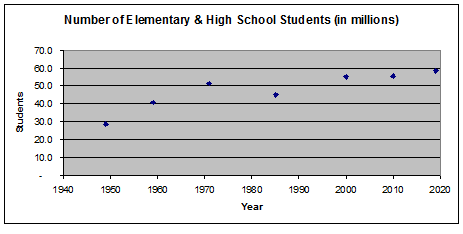
1) Big Market: Growth in K-12 Student Population

The growth of the US elementary and high school population has almost doubled in the last 60 years to 56 million.  Interestingly, much of that growth occurred from 1950-1970 with the baby boom explosion, and for the last decade, the population has remained essentially flat.   By 2019, the US DOE predicts there will be an additional 3 million K-12 students or about 60 million.

2) Fragmented Market:  Dispersion of K-12 Student Population

The 17,00 US school districts are highly fragmented:

  • ~30% of districts (nearly 5,000) have only 1 school, accounting for just 3% of students
  • ~99% of districts have 50 schools or less, accounting for 72% of students
  • Only 0.4% of districts (just 65) have more than 100 schools.  But these account for 16% of students

Share this:

  • Click to share on Facebook (Opens in new window) Facebook
  • Click to email a link to a friend (Opens in new window) Email
  • Click to share on X (Opens in new window) X
Like Loading...

Enter your email address to follow this blog and receive notifications of new posts by email.

Top Posts & Pages

  • Falling Averages: A-Rod & Baseball's Decline
  • Syria & Russia. And Tartus.
  • How Many Heart Beats Do We Get?
  • Who benefits from a stock-market boom?
  • New York City Property #2: Trinity Church

Recent Posts

  • Falling Averages: A-Rod & Baseball’s Decline
  • Syria & Russia. And Tartus.
  • How Many Heart Beats Do We Get?
  • Who benefits from a stock-market boom?
  • New York City Property #2: Trinity Church

RSS Goodness

  • RSS - Posts
  • RSS - Comments

Archives

  • September 2013
  • April 2013
  • December 2012
  • August 2012
  • July 2012
  • June 2012
  • May 2012
  • April 2012
  • March 2012
  • February 2012
  • January 2012
  • December 2011

Categories

  • Alexander Hamilton
  • Animals
  • Astronomy
  • Biology
  • Books
  • British Royalty
  • Continuing education
  • Events
  • Food
  • Hello world
  • K12
  • Khan Academy
  • Lynda.com
  • Madison Square Park
  • Maps
  • Muffins
  • Museum of the City of New York
  • Names
  • New York
  • Politics
  • Post-secondary
  • PR
  • Queen Anne
  • Queen Victoria
  • Sports
  • Statue of Liberty
  • Trinity Church
  • TV
  • Uncategorized
  • World War II

Blogroll

  • Anne Collier Photography
  • Beach Chair Scientist
  • Emiliano Granado Photography
  • Have Fun With History
  • History Channel
  • The History Blog
  • Vanishing New York

Enter your email address to follow this blog and receive notifications of new posts by email.

Join 12 other subscribers

Blog at WordPress.com.

Privacy & Cookies: This site uses cookies. By continuing to use this website, you agree to their use.
To find out more, including how to control cookies, see here: Cookie Policy
  • Subscribe Subscribed
    • Historicalness.com
    • Already have a WordPress.com account? Log in now.
    • Historicalness.com
    • Subscribe Subscribed
    • Sign up
    • Log in
    • Report this content
    • View site in Reader
    • Manage subscriptions
    • Collapse this bar
 

Loading Comments...
 

    %d