• About

Historicalness.com

~ for casual history lovers

Historicalness.com

Monthly Archives: May 2012

Photos: Best of Old New York

30 Wednesday May 2012

Posted by Matt in New York

≈ Leave a comment

If you’re a fan of old photos, you’ll love a recent post at TheAtlantic.com called “Historic Photos From the NYC Municipal Archives“.

Apparently, the Archives — which are part of the city’s Department of Records and Information Services — “just released a database of over 870,000 photos from its collection of more than 2.2 million images of New York throughout the 20th century” and TheAtlantic.com selected 53 of its favorites which you can see here.

Here are two of my favorites from their list of 53.  First, is a view from the Williamsburg Bridge looking west on Delancey Street on Manhattan’s Lower East Side — exactly the area that’s being contemplated for the Low Line Park that I mentioned in my last post.  This photo is from January 29, 1923:

Second, is the famed Sheep’s Meadow in Central Park which, based on this photo, was I guess at one time actually a meadow for sheep (circa 1900-1910:

If you’d like to see the entire catalog of the Archive’s photos, you can visit here.  The browsing functionality isn’t that great, but they have added some categories to help which you can visit here.

Share this:

  • Click to share on Facebook (Opens in new window) Facebook
  • Click to email a link to a friend (Opens in new window) Email
  • Click to share on X (Opens in new window) X
Like Loading...

The Lowline: From Abandonded Station to Futuristic Park

24 Thursday May 2012

Posted by Matt in Uncategorized

≈ Leave a comment

There’s apparently been a lot of press — all of which I’ve missed — about the Lowline.  In case you too haven’t heard, the Lowline aspires to be the world’s first underground park, tucked inside an old trolley terminal on Manhattan’s Lower East Side.

Last night I went to a talk by the Lowline’s two visionaries, James Ramsey and Dan Barasch, who view their project as a cousin of sorts to the High Line and who are taking a similar grass-roots approach to convince the city to transform this unused area into a landmark public space.

Here’s an illustration of the Lowline would look like:

The MTA controls the space due to its historical roots as the Williamsburg Trolley Terminal which shuttled passengers from October 1904 – December 1948 between Williamsburg, Brooklyn and the Lower East Side, passing underneath Delancey and Essex streets.

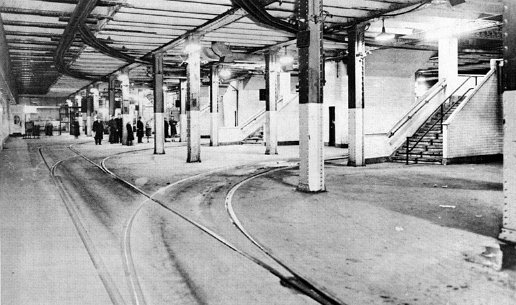
Here’s the Trolley Terminal, looking east above Delancey Street toward the Williamsburg Bridge

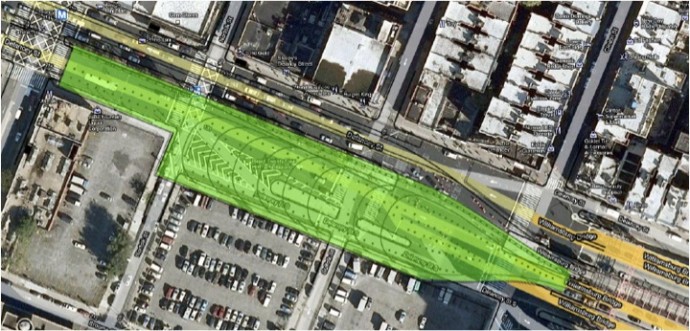
The reason why the Terminal’s space is wider than you might expect is that it includes 8 loops which the trolleys used to turn around (and which in the picture below resemble the tops of tennis racquets).

An overhead shot of Delancey Street and the Terminal, with the Williamsburg Bridge disappearing in the lower right corner.

Here’s what the loops looked like at their underground level.

What’s also fascinating is the technology that Ramsey has created to capture sunlight above ground and then transmit it down into the park to feed the trees and grass:

The Lowline could serve as a model for urban areas around the world — and there are even a bunch more abandoned stations throughout New York which might also be candidates which you can see here at a site called…Abandoned Stations.

If you’d like to learn more about the Lowline or make a donation to the cause, you can visit their site at DelanceyUnderground.org.

Share this:

  • Click to share on Facebook (Opens in new window) Facebook
  • Click to email a link to a friend (Opens in new window) Email
  • Click to share on X (Opens in new window) X
Like Loading...

What Was On the Menu?

17 Thursday May 2012

Posted by Matt in Uncategorized

≈ Leave a comment

There are a ton of places in NY and elsewhere to get great cocktails, many whose recipes were invented in an earlier era.   I’ve often wondered what people were eating when these cocktails first arrived on the scene — what were they dining on before/during/after their Sidecars and Old Fashioneds?

And, wouldn’t it be fun if restaurants today offered some of those dishes — or, if there was a spot dedicated solely to recreating the menu of the [insert decade here] in its entirely, soup to nuts (literally and figuratively).

But how do we know exactly what used to be served in restaurants around town? Enter the NY Public Library, which has a vast archive of original printed menus, some 40,000 from the 1840s to present (most from NY dining spots).

In April 2011, it launched a digital program called “What’s on the Menu?” (you can see it here), and over the past year, almost 900K dishes from 13,500 menus have been transcribed from print to digital by public volunteers — visit http://menus.nypl.org and you too can help out.

It’s a mouth-watering look into history.

Curious what Delmonico’s (the old one at 26th and 5th) was serving one October evening in 1898?

I don’t know what Filet de boeuf a la Montebello is, but I already love it

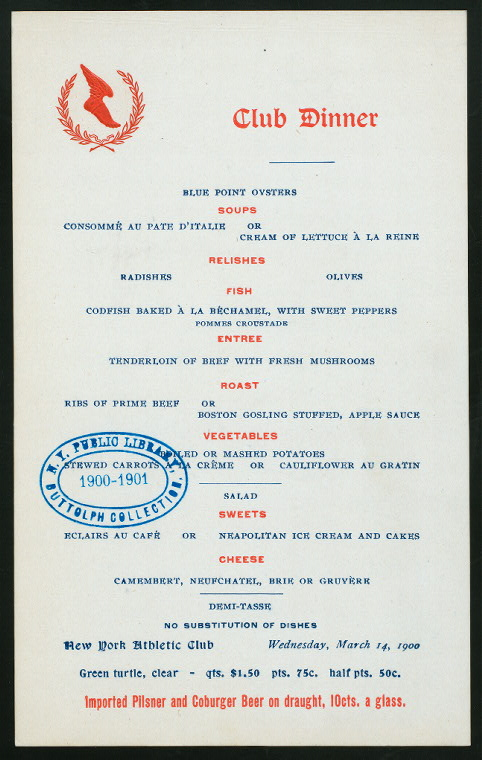
What the NY Athletic Club patrons were offered at the turn of the century?

decisions, decisions…

Or that Governor Teddy Roosevelt had a dinner in his honor on Saturday, March 11, 1900 at the Waldorf Astoria?

Looking good TR

Then this is the place for you.  Enjoy!

Share this:

  • Click to share on Facebook (Opens in new window) Facebook
  • Click to email a link to a friend (Opens in new window) Email
  • Click to share on X (Opens in new window) X
Like Loading...

The History of Chocolate

11 Friday May 2012

Posted by Matt in Food

≈ Leave a comment

In honor of Mother’s Day, I thought I’d take a look at the history of one of my mom’s favorite desserts: chocolate.

So where does chocolate from?

The earliest signs we have of chocolate consumption go back to 2,000 BC in what was called Mesoamerica (what today is roughly Central America).

And for the vast majority of chocolate’s history, it was consumed as a drink, not as a food — only in the last 150 years has chocolate emerged in the form we know it today.  In fact, the word “chocolate” is derived from the Aztec word “xocoatl,” which was a bitter drink created from cacao beans.

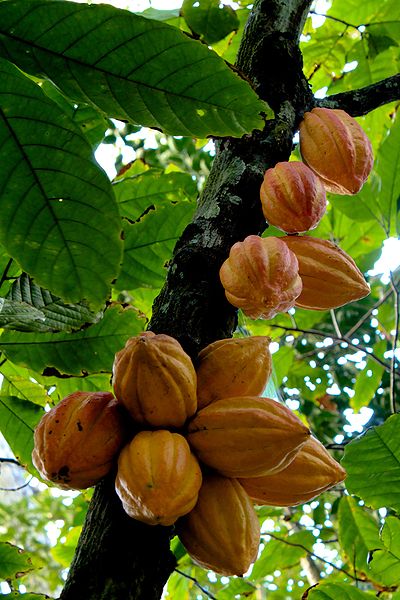
Here you can see the cacao fruit as it grows on a tree, and the seeds inside which we use to make chocolate:

For the Mayans and Aztecs, cacao was held in very high esteem: cacao pods were represented in temples, and beans were used as currency as well as to make the xocatl drinks which often had medicinal purposes.

In the 1500s, Cortez brought cacao back to Spain after conquering Mexico and it spread throughout Europe. It made its way to America in the 1700s (and was given to soldiers in the Revolutionary War).

In the mid 1800s, European chemists created the first modern chocolate bars, which soon began to be marketed by companies like Cadbury’s.  In 1875, the first milk chocolate bar hit the market.

Today, most cacao is grown in West Africa and in 2009 total chocolate candy sales were $5 billion across supermarkets, drugstores and mass merchandise outlets.  “Premium” chocolate, which has higher cocoa percentages — e.g. 70% cacao vs. a Hershey bar’s 30% cacao — has recently been a major growth area.

But if you don’t like eating or drinking it, at least you can bathe in it. Enjoy!

Share this:

  • Click to share on Facebook (Opens in new window) Facebook
  • Click to email a link to a friend (Opens in new window) Email
  • Click to share on X (Opens in new window) X
Like Loading...

Where Did $600 Billion Go?

09 Wednesday May 2012

Posted by Matt in K12, Uncategorized

≈ Leave a comment

There are 3 important things I’ve learned recently about our education system:

  1. No one knows where the dollars in K-12 education are really going (we know the sources of funding, but we don’t know how those funds are spent).
  2. This leads to inefficient and unintended uses of the funding.
  3. There are powerful structural elements — including K-12’s various stakeholders and conditions/contingencies tied to how funding is used — that work against fixing the situation.

First, a little context about the K-12 world.

    • Large: Education spending for kindergarten through 12th grade is massive, totaling $600 billion, which is about $12,000 per year per student (with WIDE variations on per student spending depending on the state and district you live in, roughly from $5K-$15K).
    • Growing: Spending on K-12 education has grown 2-3x over last 30 years (even when adjusting for inflation).  Federal funding alone has doubled in the last decade.
    • Funding Sources #1 – 10/45/45: The $600 billion is funded 10% from federal dollars, 45% from state (sales & income taxes), and 45% from local (property taxes).
    • Funding Sources #2 – Taxes:  Education funding is the largest claim on your tax dollars except for Medicaid.

I spent some time with Marguerite Roza at the University of Washington’s College of Education who is the country’s expert on K-12 financing.  Her book, Educational Economics: Where Do School Funds Go?, is terrific — short, sweet, and clearly written — and I’ve excerpted a number of items from it below.

So, revisiting the three things I’ve learned….

1) No one knows where the dollars in K-12 education are really going (we know the sources of funding, but we don’t know how those funds are used).

How can this be true?  Well, the problem is districts don’t track what they spend on each school.  Seems like this would be pretty important, but they don’t do it.

As a result, “despite extensive financial reporting requirements, most districts cannot answer basic questions [such as]: How much does the district spend on professional development?…How much does the district spend on sports and electives? How much does Johnson Elementary receive relative to Lincoln Elementary?” (pg 47).

2) This leads to inefficient and unintended uses of the funding.

There are many examples, but let’s pick one with a particular historical connection.

In 1965, LBJ launched the War on Poverty and with it created a new federal education program called Title I.  The program was well-intentioned: it was meant to provide funds to schools with the highest concentrations of poverty.  More specifically, it was meant to provide incremental funds ON TOP of an equitable distribution of all other funds across all the schools in a district, so Title I would provide a real boost to the students most affected by poverty.

To this day, Title I is the largest slice of the $60 billion federal edu pie at $15 billion per year.  The problem is, it’s not working as intended.

How can this be?  To have any sense for where money goes in K-12, it helps to start by looking at compensation, as salaries and benefits count for ~70% of spending (we think!).

Since more experienced and therefore more expensive teachers (due to seniority vs. merit-based compensation plans) choose to teach in wealthier schools with middle & upper-class students, these schools receive more funding by way of higher salary spending.  For instance, 1 teacher in poor school tends to be less experienced so gets $40K whereas 1 teacher in a wealthy school tends to be more experienced so gets $60K.

The funding gap between schools with wealthy and poor student populations is so large that Title I dollars cannot make up for it — instead of providing a boost, it can’t even provide a level playing field.  So the highest poverty schools actually receive less than wealthier schools — completely opposite of what is intended.

Targeted Federal Funding atop Uneven Base Allocations in One School District (pg 35)
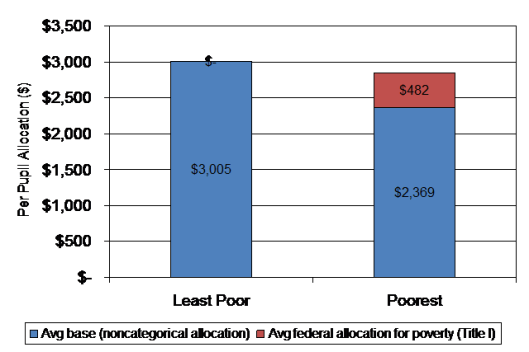
As a result, we’ve reached a world where, “one could argue that the implicit [my emphasis] strategy in spending realized at the school level is one where the system:

  • is trying to increase the gaps between minorities and whites;
  • reinforces the benefits realized by wealthier students;
  • is working to expand the achievement gap between high and low performers” (pg 68).

3) There are powerful structural elements — including K-12’s various stakeholders and conditions/contingencies that limit how funding is used — that work against fixing the situation.  

There are numerous stakeholders who are involved in the K-12 world: school boards, superintendents, central office staff, principals, parents, and political officials at the local, state and federal level.  Why is this necessarily a problem?

Well all these chefs each vie for their own favored projects — and those better at working the system assert greater influence over where funding goes vs. programs (e.g. Title I) intended to sure equitable distribution.  For instance: “Parents band to block school closures and prevent budget cuts to cherished programs.  In one district, students marched into a [school] board meeting playing their musical instruments, thus saving the middle-school music program in a single school.” (pg 30)

In addition, more chefs lead to more rules which limit a school’s site-based discretion.   For instance: “In [one] school, the district continues to provide bus transportation to all students to the school, despite the fact that more than half could safely walk.  The principal wants to redirect the funds to other services but says the district cannot, since those funds are earmarked by the state for transportation only.”  (pg 66)

What to Do?

There is no magic solution.  But I do think there are opportunities to (a) advise districts on how to better make use of and understand their data as well as (b) create technology solutions to track spending down to the school level — not just software to enable compliance, but software to enable insight into where money really goes and whether it’s being spent in ways that drive student achievement.
Share this:

  • Click to share on Facebook (Opens in new window) Facebook
  • Click to email a link to a friend (Opens in new window) Email
  • Click to share on X (Opens in new window) X
Like Loading...

Enter your email address to follow this blog and receive notifications of new posts by email.

Top Posts & Pages

  • Falling Averages: A-Rod & Baseball's Decline
  • Syria & Russia. And Tartus.
  • How Many Heart Beats Do We Get?
  • Who benefits from a stock-market boom?
  • New York City Property #2: Trinity Church

Recent Posts

  • Falling Averages: A-Rod & Baseball’s Decline
  • Syria & Russia. And Tartus.
  • How Many Heart Beats Do We Get?
  • Who benefits from a stock-market boom?
  • New York City Property #2: Trinity Church

RSS Goodness

  • RSS - Posts
  • RSS - Comments

Archives

  • September 2013
  • April 2013
  • December 2012
  • August 2012
  • July 2012
  • June 2012
  • May 2012
  • April 2012
  • March 2012
  • February 2012
  • January 2012
  • December 2011

Categories

  • Alexander Hamilton
  • Animals
  • Astronomy
  • Biology
  • Books
  • British Royalty
  • Continuing education
  • Events
  • Food
  • Hello world
  • K12
  • Khan Academy
  • Lynda.com
  • Madison Square Park
  • Maps
  • Muffins
  • Museum of the City of New York
  • Names
  • New York
  • Politics
  • Post-secondary
  • PR
  • Queen Anne
  • Queen Victoria
  • Sports
  • Statue of Liberty
  • Trinity Church
  • TV
  • Uncategorized
  • World War II

Blogroll

  • Anne Collier Photography
  • Beach Chair Scientist
  • Emiliano Granado Photography
  • Have Fun With History
  • History Channel
  • The History Blog
  • Vanishing New York

Enter your email address to follow this blog and receive notifications of new posts by email.

Join 12 other subscribers

Blog at WordPress.com.

Privacy & Cookies: This site uses cookies. By continuing to use this website, you agree to their use.
To find out more, including how to control cookies, see here: Cookie Policy
  • Subscribe Subscribed
    • Historicalness.com
    • Already have a WordPress.com account? Log in now.
    • Historicalness.com
    • Subscribe Subscribed
    • Sign up
    • Log in
    • Report this content
    • View site in Reader
    • Manage subscriptions
    • Collapse this bar
 

Loading Comments...
 

    %d